Principal Research Scientist · Leidos, Inc.
Vasanth Sarathy
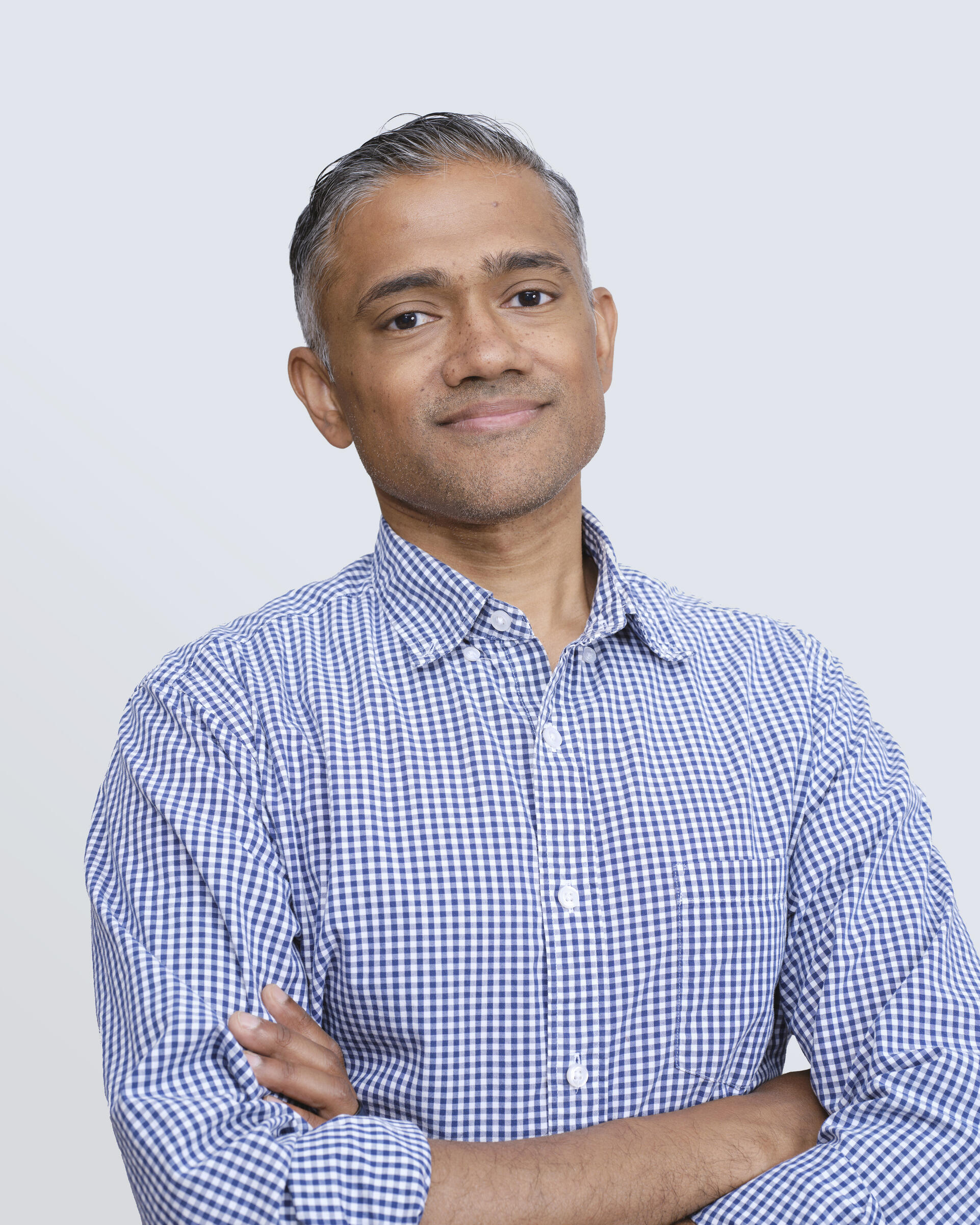
I work on reasoning assurance: specifying what good reasoning requires, verifying whether AI systems meet those specifications, monitoring them at runtime, and improving them against the same specifications. The aim is reasoning that can be inspected, contested, and trusted on the basis of evidence rather than on a system's own account of itself.
The failures I focus on lie in the implicit layer: assumptions an argument never states, norms a context never announces, beliefs an interlocutor does not share, reasoning a model reports but does not perform. My work aims to make that layer explicit, and then checkable.
Technically, this means combining methods that are usually pursued separately.
- Logic
- Modal and epistemic logic, deontic logic, answer set programming, assumption-based argumentation — the languages the specifications are written in.
- Uncertainty
- Interval and set-valued representations, uncertainty quantification, calibration — ignorance, ambiguity, missing information, and conflict are distinct problems, not one number.
- Interpretability
- Inspectable by construction (vector-symbolic architectures, hyperdimensional computing) or recovered after the fact (probes, attribution, interventions) — superposition is the shared mathematics.
- Planning & RL
- Symbolic planning, policy shaping, reinforcement learning — sequential decision making and long-horizon goal-directed behavior.
- Language
- Argumentation and informal logic, dialogue and pragmatics, common ground and theory of mind — reasoning conducted between agents rather than inside one.
More on the research program →
At Leidos, I lead a research team working on secure agentic AI: verification systems that decompose model outputs into claims, evidence, assumptions, and uncertainty, so that reasoning failures can be caught before they reach high-stakes decisions. I also maintain open-source tooling — an epistemic model checker, an argumentation library, and a GPU-native vector-symbolic library.
Before AI, I spent nearly a decade as an intellectual property attorney at Ropes & Gray. Law is adversarial reasoning as a profession, and I bring that toolkit to stress-testing AI systems.
Recent work
- Does the model reason correctly about norms? Where Norms and References Collide: Evaluating LLMs on Normative Reasoning AAAI 2026 · oral
- Does its reasoning survive deliberate manipulation? CogSLLaM: Cognitive Security for Large Language Models AAAI-SS 2026 · oral
- How do you evaluate reasoning that acts? On Evaluating LLM Integration into Robotic Architectures TIST 2025
- Can arguing both sides unlock hidden reasoning? "Let's Argue Both Sides": Argument Generation Can Force Small Models to Utilize Previously Inaccessible Reasoning Capabilities EMNLP-W 2024
- Does it reason correctly about people? Large Language Models Know What To Say But Not When To Speak EMNLP 2024
Background
Previously, I was a Research Assistant Professor of Computer Science at Tufts University, where I led $2M+ in DARPA-funded research on LLM over-trust and reasoning, and a Senior Research Scientist at Smart Information Flow Technologies (SIFT), where I authored and won $3M+ in competitive DARPA funding as PI and led AI efforts for U.S. defense and intelligence programs.
I hold a dual Ph.D. in Computer Science and Cognitive Science from Tufts University, where I was advised by Matthias Scheutz and Dan Dennett. I also earned an M.S. from MIT, a B.S. from the University of Arkansas, and a J.D. from Boston University School of Law.
This 2023 BU Law article summarizes my journey.
Beyond research
Outside of work, I explore restaurants and travel with my wife and three kids. When I have some spare time, I draw in pen-and-ink, practice shaolin-kempo-karate style martial arts, and build research software and creative tools.
I also co-host Code and Cure, a podcast on decoding health in the age of AI, with an emergency medicine–trained physician.
Contact
I'm always glad to talk about evaluation of reasoning and agentic systems, cognitive security, or AI and law. Email me at vasanth@alum.mit.edu, or find me on Google Scholar, GitHub, and LinkedIn.